Why Learning First
Two words. They sound simple. They are not.
If you've never worked inside a school building, you might be surprised how hard it actually is for educators to put learning first. Not because they don't want to. Because almost everything in a school day is competing for that spot.
Legislation keeps shifting, and most of it isn't asking "are kids learning?" — it's asking for more documentation, more compliance, more proof of process. Mental health needs in kids and in teachers keep climbing, and that shows up as behavior, which eats instructional time before a lesson even starts. And underneath all of it, a lot of teachers are walking into their buildings without a clear system telling them what to teach or how to teach it well. They get a textbook and a hope that the textbook will do the job preparation didn't.
And yet — every single day, teachers and school leaders put the cape on anyway. They walk in and do the hard work of trying to give every kid a real shot at a real education. That's the promise this whole profession was built on. Horace Mann didn't advocate for public education so kids could pass a test. He advocated for it so every child could gain the skills to build a good life — and then turn around and strengthen their community, and the world, with it. That vision gets harder to protect every year. Not because people stopped caring. Because the noise around learning got louder than learning itself.
I can't fix all of that. I wish I could. What I can do is focus on the one piece I know best: curriculum and instruction systems.
The Gap I Keep Finding
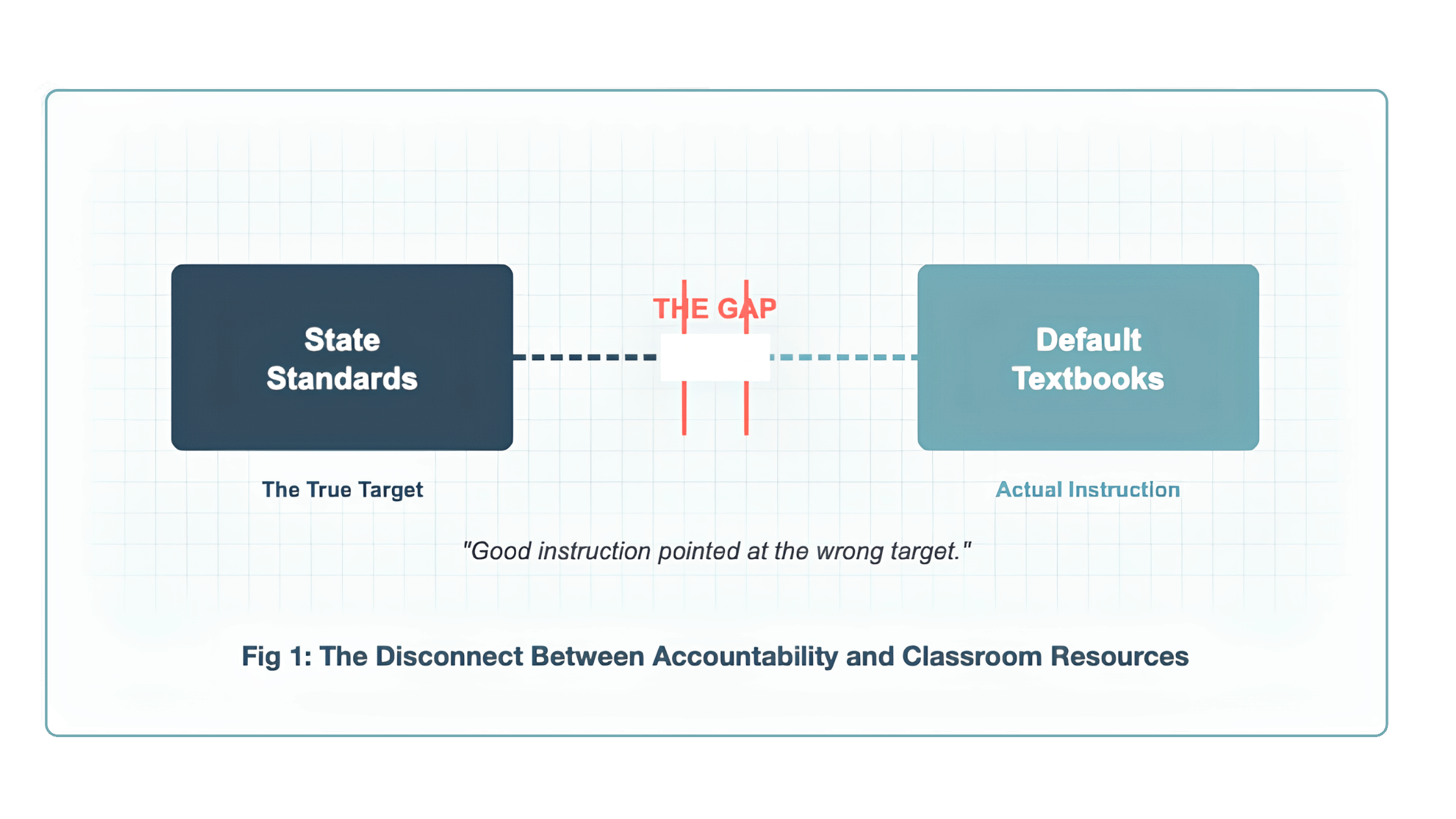
After working alongside more than 120 schools across Missouri, I keep finding the same gap. Schools are held accountable to state assessments built on standards. Meanwhile, in a lot of classrooms, teachers are teaching from resources that were never actually aligned to those standards in the first place.
So when a teacher does get a moment to focus on learning — really focus — they're often teaching the wrong things well. Good instruction pointed at the wrong target.
A big piece of this comes from how many teachers enter classrooms underprepared for the instructional decision-making the job actually requires. Districts respond, understandably, by handing them a textbook with scripted, step-by-step lessons — hoping the resource can quietly cover for gaps in preparation and skill. I understand why this happens. But it doesn't work. It usually makes things worse.
When a textbook becomes the default source of truth, teachers are never required to sit with the actual rigor and complexity of the standards their students need to master to be college and career ready. The reliance on the resource replaces the understanding of the target. And that gap — between what the resource delivers and what the standard actually demands — quietly widens the achievement gap it was supposed to help close.
So What Actually Closes It?
Leaders. Leaders who see the gap clearly enough to act on it systematically.
Every administrator eventually has to sit with an uncomfortable truth: learning doesn't automatically come first just because we say it should. It comes first when teachers walk into their buildings with clarity — not motivation, not good intentions, clarity. A one-page map that shows them exactly which standards they're responsible for and exactly how their resources connect to those standards. Then, just as important, they need to be taught how to actually use that resource as a tool in service of the standard — not as the standard itself. That means auditing it, reorganizing it where needed, and protecting the rigor of what students are supposed to walk away knowing.
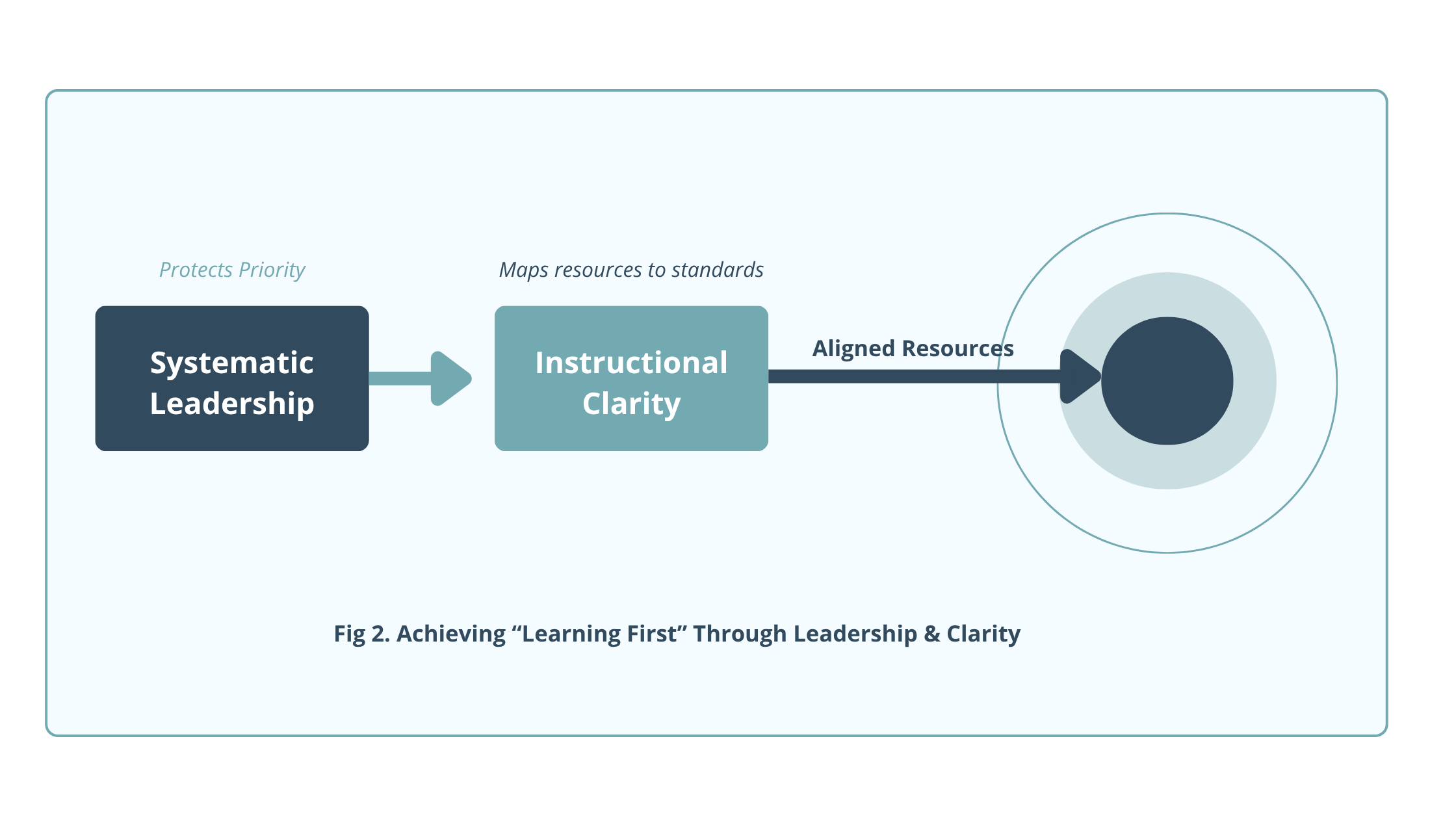
Every teacher deserves to walk into a building that says, without ambiguity: we prioritize learning here, and we're going to make sure you can see exactly how your daily work connects to it.
That single shift won't solve everything. The next steps — real clarity on what mastery looks like, how to assess it, and what excellent instruction looks like in the room — still have to follow. But you close a gap one deliberate step at a time, not all at once.
Why the Name
That's why I named this work Learning First. Not because it's obvious. Because it's the opposite of obvious — it's the one priority every other pressure in a school building will happily crowd out, if leaders don't protect it on purpose.
The name isn't a slogan. It's a decision I'm asking school leaders to make, over and over, on the days when it would be so much easier not to.
Are you going to be a leader who puts learning first?
I hope you do. If you want help, we are here to help.